
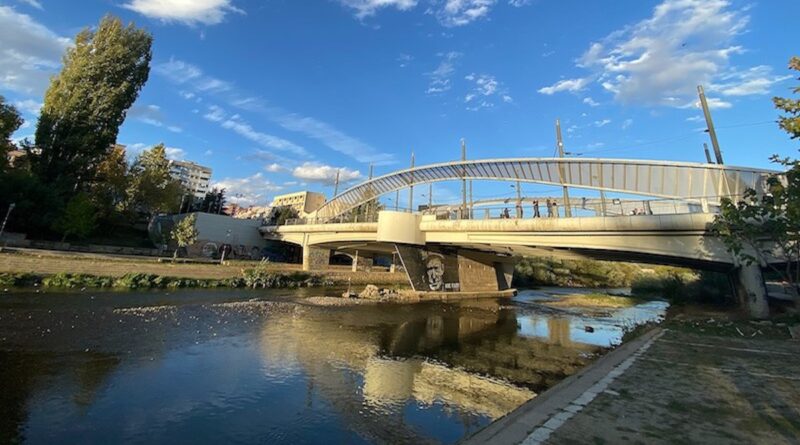
Ibar Bridge in Mitrovica, Kosova. Photo Credit: GentiBehramaj, Wikipedia Commons
From Vučić’s Statement to the Failure of the Project to Partition Kosova
Key Takeaways:
- Serbia’s Vučić frames the Ibar Bridge as part of the dialogue, but the author reads the gradual handover of security from KFOR to Kosova police—and moves toward opening it—as a shift from a frozen, divided status quo toward Kosovo’s institutional control of the north.
- For years the closed bridge symbolized parallel structures and incomplete sovereignty; its normalization weakens scenarios of lasting autonomy or border revision that once linked Association talks and “border correction” ideas.
- Opening the bridge would not end Serbia’s claims or resolve Serb-community rights, but it would signal that northern integration is advancing and that time is no longer automatically favoring partition.
Introduction
“The bridge over the Ibar River was part of the dialogue; now they want to remove it.”
This statement by Serbian President Aleksandar Vučić is not merely a political reaction to an infrastructure or security issue. It deserves to be read within a broader context: that of the gradual transformation of the political and institutional order in northern Kosova.
For more than two decades, the bridge over the Ibar River in Mitrovica has been one of the most powerful symbols of the division of post-war Kosova. It has functioned not merely as a restricted crossing point, but also as a material manifestation of a political status quo in which the de facto division of the city reflected a deeper institutional, political, and psychological division.
Precisely for this reason, the change in the security regime around the bridge and the gradual transfer of responsibility from the international presence to the institutions of the Republic of Kosova should not be viewed merely as an operational development. It can be understood as an indicator of a deeper transformation: the transition from an exceptional situation of international management of a sensitive area toward the normalization of the state’s institutional responsibility.
The central thesis of this analysis is that the Ibar Bridge should be viewed as a symbolic and strategic node in the process of integrating northern Kosova. In this sense, the developments surrounding it do not constitute an isolated episode. They are connected to a series of political calculations that, at different times, have sought to preserve the north in a distinct institutional state and, in a broader scenario, to create the conditions for the territorial fragmentation of Kosova.
Therefore, the fundamental question is not merely whether the bridge will be opened or not. The more important question is: what political order does its opening signify, and what strategic paradigm is it replacing?
The Bridge as a Symbol of the Status Quo
For approximately 27 years, the bridge over the Ibar has been one of the most powerful symbols of the division of Mitrovica. Physically, it divided two parts of the city; politically, it embodied a much deeper dividing line: the boundary between an institutional order that the Republic of Kosova sought to extend throughout its territory and a parallel reality politically, financially, and institutionally supported by Belgrade.
This is why the bridge cannot be treated simply as infrastructure.
The bridge was simultaneously a physical space, a political symbol, and an instrument of the status quo.
In this case, the status quo did not necessarily imply stability. On the contrary, a frozen situation can serve as a strategic instrument when one side seeks to preserve a temporary reality in the hope that, over time, it will become an established and enduring reality.
In the case of northern Kosova, this logic was particularly important. A territory institutionally fragmented, with parallel structures and controlled points of movement, could create the impression that the sovereignty of the Republic of Kosova was incomplete or temporary.
In this sense, the bridge was more than a bridge.
It was one of the most visible signs of an unfinished political order.
From International Presence to Institutional Responsibility
The new development emerging around the bridge is particularly significant because of the changing nature of security responsibility.
The NATO-led KFOR mission in Kosova has announced that it has begun the gradual transition of KFOR’s permanent presence from the Ibar Bridge in Mitrovica, while responsibility for security is gradually being transferred to the Kosova Police. At the same time, a signal has come from Brussels that the conditions for opening the bridge have been fulfilled.
“The NATO-led KFOR mission has begun the gradual transition of its permanent presence from the Main Bridge in Mitrovica. In line with the improvement of the security situation in Kosova, this is part of the process of optimizing KFOR’s posture,” an official statement reported by the media said.
At first glance, this may appear to be a technical change. Strategically, it is not. The responsibility of an international institution for securing a sensitive security point and the responsibility of a state institution for the same point carry different political meanings.
The former expresses an exceptional situation, inherited from the conflict and temporarily managed by the international community.
The latter expresses institutional normalization.
This distinction is essential. If an important point in the public space can be administered and secured by the institutions of the Republic of Kosova, then we are witnessing a change in the very logic of the international presence.
This does not mean that the international presence is losing its importance. On the contrary, it may shift from the direct management of exceptional situations toward a broader role as a guarantor of security.
But politically, the change is clear: a state institution is assuming responsibility that was once considered necessary to remain under international supervision.
The Brussels Dialogue and the Dilemma of the North
To understand the significance of this development, attention must be turned to the political architecture created after 2013.
The Brussels Agreement of April 2013 and the subsequent agreements, including those of 2015, placed at the center of the dialogue the issue of integrating Serbian structures and the Serbian community into Kosovo’s institutional system, including the project of an Association/Community of Serb-majority municipalities.
This process has long been the subject of differing interpretations.
On the one hand, it could be viewed as an effort to institutionally integrate the Serbian community and create mechanisms for protecting its rights.
On the other hand, there was concern that a structure with broad powers could turn into a mechanism for territorial autonomization and, under certain circumstances, produce a reality similar to that of Republika Srpska in Bosnia and Herzegovina.
This is precisely where one of the most important knots in the political history of post-war Kosova lies:
Would the dialogue be used to normalize and integrate the north, or to institutionalize a form of territorial autonomy that would further fragment the state?
This question is not merely legal. It is simultaneously political, institutional, and geopolitical.
From the Association to the Project of Changing the Borders
An even further step in this direction was the project to alter Kosova’s territorial boundaries, which emerged forcefully during the 2018–2020 period through political discussions between Hashim Thaçi and Aleksandar Vučić, a process in which Albania’s Prime Minister Edi Rama was also politically involved.
The idea was articulated under various labels: “border correction,” “territorial exchange,” or “historic compromise.”
Regardless of the terminology, however, its essence was a shift in the dialogue from the normalization of relations toward territorial revision.
This was a critical moment.
A change in Kosova’s borders could have created a precedent for reopening unresolved territorial questions left behind by the dissolution of Yugoslavia. Moreover, such a precedent could have had consequences for Bosnia and Herzegovina, North Macedonia, Montenegro, and other parts of the Balkans.
The project, however, failed to materialize.
Meanwhile, developments surrounding the Kosova Specialist Chambers in The Hague dramatically altered the political circumstances surrounding Hashim Thaçi, who was arrested in November 2020 after the indictment against him had been confirmed.
Nevertheless, reducing this process solely to the political fate of one individual would be insufficient.
The decisive blow to the territorial-revision project came from another factor: the change in the political will of the citizens of Kosova.
February 14, 2021 – The Political Turning Point
The parliamentary elections of February 14, 2021 marked an important turning point in Kosova’s politics.
They represented not simply an ordinary electoral rotation. It was no coincidence that we characterized them as a silent democratic revolution. Their outcome expressed strong public rejection of an old model of governance and of an important part of the political calculations that had developed around Kosova.
In this sense, February 14 can be seen as a turning point in the relationship between domestic politics and the geopolitical processes connected to Kosova.
The project of territorial revision, which de facto implied the annexation of the north by Serbia, lost the political foundation it would have needed to become an institutional reality.
This was essential.
Because geopolitical projects are not realized through international diplomacy alone. They also require a domestic political foundation capable of providing them with legitimacy.
After 2021, the political dynamics in the north gradually began to change. The institutional integration of this part of Kosovo’s territory was placed more firmly at the center of state policy.
It is in this perspective that the recent developments surrounding the Ibar Bridge should also be understood.
Why Is Vučić Concerned?
This perspective also helps explain the reaction of Aleksandar Vučić.
If the bridge was “part of the dialogue,” as he claims, then the fundamental question is: what political function did the bridge have within that dialogue?
If it was supposed to remain closed or under a special security regime as a result of the dialogue, then changing this reality weakens one of the elements of the status quo that Belgrade had managed to preserve for a long period.
If, on the contrary, the bridge gradually returns to normal use and responsibility for its security is transferred to Kosova’s institutions, then we are witnessing a paradigmatic shift.
This is why Belgrade’s reaction should be read beyond the rhetoric of the moment.
The dialogue cannot be transformed into a mechanism for permanently freezing the post-war reality. The purpose of the dialogue should be normalization. And normalization, in its institutional sense, means that bridges are opened, divisions diminish, movement is normalized, and institutions function.
If a bridge continues to serve as a symbol of division more than two decades after the end of the war, then it can no longer be regarded merely as a technical issue. It is part of an unresolved political problem.
From the “Dividing Line” to the City Bridge
For a long time, the bridge functioned as a dividing line. It divided Mitrovica physically and psychologically.
But if it is opened—as Brussels has now also signaled—and responsibility for its security is transferred to Kosovo’s institutions, the bridge begins to transform from a symbol of division into the normal infrastructure of a single city.
This is also an important change at the symbolic level.
Sovereignty is manifested not only through constitutional documents, laws, and political declarations. It is also manifested through the everyday practices of the state:
Who guarantees public order?
Who controls movement?
Who administers public space?
Who guarantees the security of citizens?
Who is accountable to them?
These questions may appear simple, but in essence they touch upon one of the most concrete dimensions of sovereignty.
In this sense, the gradual transfer of security responsibility from KFOR to the Kosova Police represents a step toward the normalization of the functioning of the state.
And it is precisely this normalization that Belgrade has opposed in various forms for a long time.
The Integration of the North and the Rights of the Serbian Community
Nevertheless, it would be methodologically and politically incorrect to conclude that the opening of the bridge brings an end to the political issue concerning Serbs in Kosova.
It does not.
The issue of the rights of the Serbian community, political representation, security, property, cultural heritage, and mechanisms for the protection of communities remains part of Kosova’s political and constitutional order and of the dialogue with Serbia.
But here a fundamental distinction must be made: The rights of a community are not the same thing as the territorial claim of another state.
Kosovo Serbs should have—and do have—full rights as citizens and as a constitutional community. This is part of the democratic nature of the Republic of Kosovo itself and of its constitutional obligations. But the protection of the rights of a community cannot be interpreted as the source of a territorial right for a neighboring state.
Therefore, the institutional integration of the north should not be presented as a “loss” for Kosova Serbs. On the contrary, from a democratic perspective, integration should mean that Serbian citizens in the north become full participants in Kosova’s institutional order, with equal rights, responsibilities, and guarantees.
A democratic state is not consolidated by excluding its communities, but by integrating them into a common legal and institutional order.
The Closing of a Strategic Era
This is also where the broader significance of the developments surrounding the Ibar Bridge lies.
They do not mark the end of Serbia’s claims toward Kosova. Nor do they mark the end of Belgrade’s efforts to keep the Kosovo issue open.
But they may mark a significant blow to the political architecture that sought to keep the north in a state of permanent suspension.
For more than two decades, part of the calculation was that time could work in Serbia’s favor: a divided north; parallel structures; a special security status; an Association with broad powers; and, at an opportune moment, an agreement on “border correction.”
If these elements could be combined at a politically favorable moment, they could create the basis for a territorial solution.
But this logic has encountered a different reality.
The Republic of Kosovo has continued to consolidate its institutions. After February 14, 2021, the balance of political forces within the country changed significantly. Meanwhile, the north has entered a new process of institutional integration.
Now, with one of the north’s most symbolic sites gradually moving from an exceptional international regime toward institutional responsibility by Kosovo, another dimension of this process is emerging.
Conclusion: From the Status Quo to Normalization
The Ibar Bridge should neither be romanticized nor overestimated. Its opening does not resolve the Kosovo–Serbia conflict, eliminate Belgrade’s territorial claims, or bring the process of fully integrating the north to an end.
But its significance lies not only in its physical function.
Its significance lies in what it symbolizes.
For more than two decades, the bridge was one of the most visible signs of a divided reality: a divided city, fragmented administration, an exceptional international presence, and a political space in which the status quo could be interpreted as an alternative to normalization.
Now, if the process of opening the bridge is accompanied by the transfer of security responsibility to Kosovo’s institutions and by guarantees for the rights of all citizens, then its political meaning changes.
The bridge moves from being a symbol of division to becoming infrastructure of connection.
That is the essence of the change.
A state’s sovereignty is measured not only by international recognition or constitutional provisions. It is also measured by the ability of its institutions to exercise their responsibilities lawfully, sustainably, and equally throughout the territory.
Therefore, the gradual transfer of responsibility from exceptional international management to Kosovo’s institutions should be viewed as part of a broader process of institutional normalization, consolidation, and functionalization of the Republic.
In this sense, Vučić’s statement represents a political paradox.
He defines the bridge as “part of the dialogue,” but his own concern demonstrates that the bridge has been part of a political order that Belgrade would prefer to preserve.
Meanwhile, its opening shifts the meaning of the dialogue: from managing a frozen division toward normalizing an institutional reality.
Therefore, the Ibar Bridge may mark the symbolic end of an era, not because its opening brings the political conflict between Kosovo and Serbia to an end, but because it demonstrates that the reality in the north is evolving not toward territorial partition, but toward institutional integration.
Strategically, this is more than the opening of a bridge.
It is an indicator that time is no longer automatically working in favor of the project of fragmentation.
And precisely here lies the deeper meaning of this development:
The Ibar Bridge is not merely a crossing over a river. It is a passage from an era of the status quo toward a new era of institutional normalization.
In this sense, its opening may mark not the end of the conflict, but the closing of a cycle of strategic calculations aimed at partitioning Kosova.
