
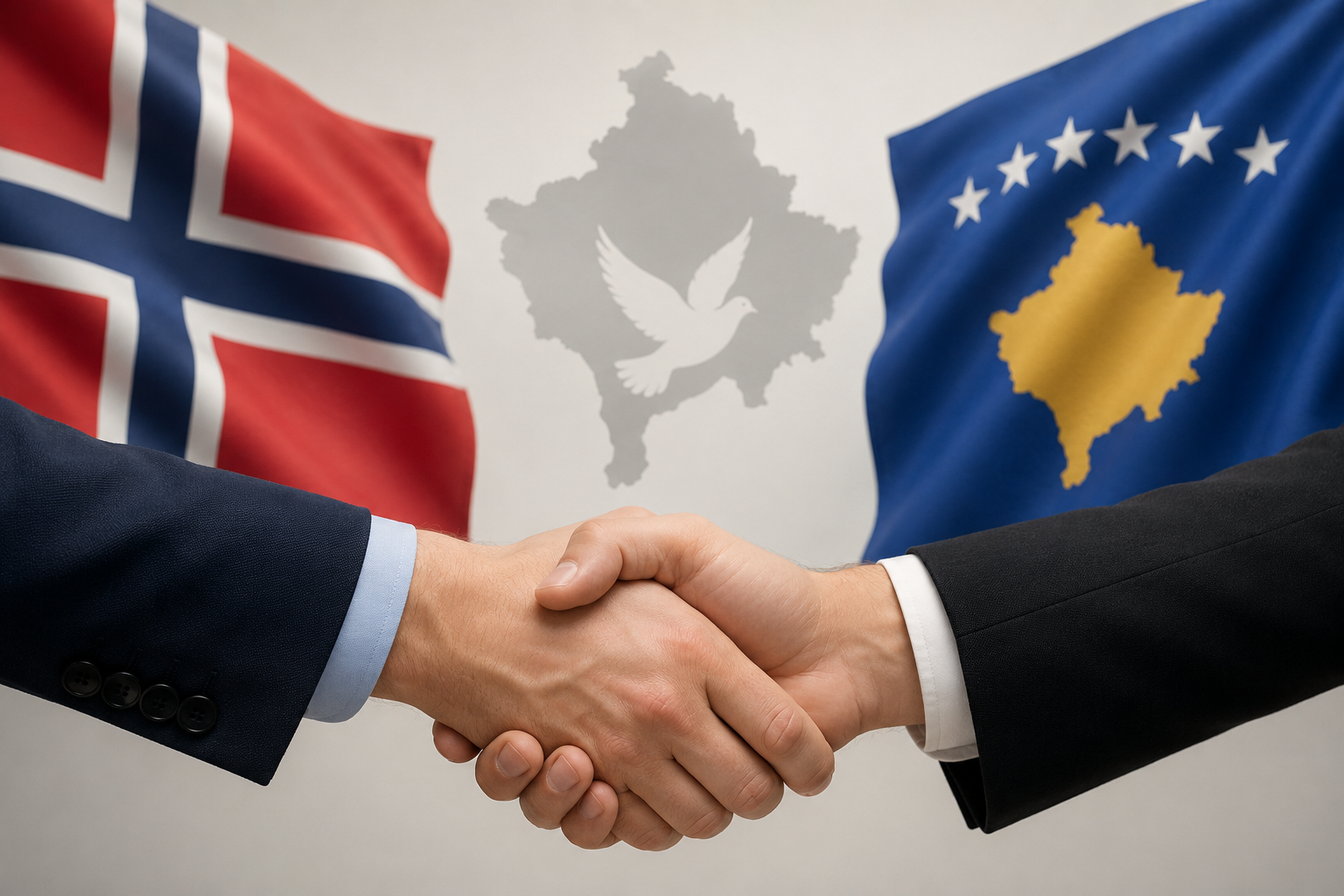
A long history of solidarity with Kosovo, built on the protection of human rights and efforts to internationalize its issue, makes the Norwegian Helsinki Committee one of the earliest and most important Western friendly structures of Kosovo. Since the late 1980s, through the Kosovo Group, this Committee was entrusted with a special role in documenting the situation in Kosovo, establishing the first connections with Western political circles and supporting Albanian democratic voices. The first visits of Kosovar delegations to the West, reports on human rights violations and the engagement of figures such as Berit Backer and Kristoffer Gjøtterud left important traces on the path that led to the internationalization of the Kosovo issue.
For this reason, the proposal to honor the Norwegian Helsinki Committee is not just an act of gratitude for a friendly organization. It is an appreciation for an important chapter in Kosovo’s history and for the people who, at a time when its voice was barely heard in the West, worked to make that voice heard.
PROPOSAL FOR HONOR 7 November 2025
To: The Office of the President of the Republic of Kosova
Subject: The Norwegian Helsinki Committee
Justification:
The Norwegian Helsinki Committee was the first organization in the West to include the issue of Kosova on its agenda — a development that marked a significant historical moment, as for the first time, efforts to internationalize the Kosova issue became an official part of the agenda of an influential Western organization.
Being an almost semi-governmental organization, with an advisory role to the Norwegian Ministry of Foreign Affairs (MFA) and considerable influence within the International Helsinki Federation (IHF), the Norwegian Helsinki Committee gave the Kosova issue a new international dimension, turning it into a genuine topic within the Helsinki Process. This process, based on the Helsinki Final Act (1975), developed on two interrelated levels: through the international civil activity of the Helsinki process, led by the International Helsinki Federation for Human Rights (IHF), and through the intergovernmental activity of the Helsinki process, carried out by state delegations within the framework of the Conference on Security and Cooperation in Europe (CSCE). The latter was conceived as an arena for dialogue between East and West during the Cold War period and introduced an essential innovation: the inclusion of human rights as a distinct principle in interstate relations. This meant not only facing criticism for possible violations of these rights but also that the human rights situation in CSCE member states became a subject of discussion at various political levels. As a result, the issue of human rights became a dominant theme of discourse among the CSCE member states throughout the Helsinki Process. The Western countries criticized the Eastern ones for violations of political and civil rights, while the latter rejected the criticism by referring to one of the fundamental principles of the Helsinki Final Act — the principle of non-interference in internal affairs. At the same time, they accused the West of violating economic and social rights.
The legacy of the Helsinki Process remained highly influential even after the institutionalization of the CSCE, which in 1995 took the form of the Organization for Security and Cooperation in Europe (OSCE). This development contributed to reducing the absolute importance of the principle of non-interference and to affirming human rights as an international standard. This, however, does not mean that the Westphalian principle — now also included among the fundamental principles of the Helsinki Final Act — was abolished or disappeared. It remained in force as a guiding principle of interstate relations, but its significance diminished insofar as it concerned respect for human rights. In this sense, violations of fundamental rights could no longer be considered merely internal matters, but legitimized international reaction, especially in cases where state regimes infringed upon basic citizens’ rights and caused humanitarian crises. At the same time, this process contributed to the consolidation of European policies of security and peace through NATO. In this context, for the implementation of peacekeeping operations, the OSCE could request military support from NATO or the EU — as was the case with Kosova. Fortunately, during that period, Norway — a country with extensive expertise and a strong humanitarian commitment within the framework of the Helsinki Process — held the role of the OSCE’s chairing state during the war in Kosova.
Seven main reasons for the proposal to honor the Norwegian Helsinki Committee (NHC)
1. The NHC encouraged and supported the organization of the first fact-finding mission to Kosova concerning the human rights situation there. The delegation consisted of individuals with direct influence within the network of the Helsinki Civil Process, who also enjoyed friendly relations and cooperation with important figures within this network. This was of particular importance, since, unlike the Council of Europe and the United Nations, the less bureaucratic organizational structure of the CSCE created greater space for influence and “bottom-up” lobbying. In this way, the Helsinki Civil Process — through the International Helsinki Federation, composed of the National Helsinki Committees — exerted a significant influence on the Intergovernmental Helsinki Process, especially in relation to the delegations of Western states within the CSCE framework. Specifically, this delegation traveled to Kosova before the fall of the Berlin Wall and aimed to observe and analyze the human rights situation. Among others, it consisted of: Karl von Schwarzenberg, Chairman of the International Helsinki Federation — a friend and collaborator of Václav Havel; Kenneth Anderson, representative of American Helsinki Watch — a friend and collaborator of Jeri Laber, Vice President of the International Helsinki Federation and Executive Director of American Helsinki Watch; and Kristoffer Gjøtterud, representative of the Norwegian Helsinki Committee — a friend and collaborator of Andrei Sakharov. In fact, this delegation traveled to Kosova under the guidance of Berit Backer, who at that time acted as a coordinator between the Group for Kosova — which operated within the Norwegian Helsinki Committee (GKNHC) — and the International Helsinki Federation (IHF).
Backer also made a special contribution to the collection and interpretation of information on the human rights situation during the stay of this delegation in Kosova. As a result, in January 1990, the first report on the situation in Kosova was published by this joint delegation, authored by Kenneth Anderson, titled “…Crisis in Kosova.” This report presented concrete recommendations to decision-makers in the European Community, the Council of Europe, and U.S. foreign policy regarding developments in Kosova. The information and recommendations contained in this report — prepared by a delegation of such stature — were of particular importance, as they provided an independent and credible overview of the situation on the ground. Moreover, as an important part of the International Helsinki Federation, the American Helsinki Committee, namely American Helsinki Watch (later known as Human Rights Watch), played a significant advisory role in U.S. foreign policy, particularly for the American delegation within the framework of the CSCE. During the period 1986–1989, this delegation was led by Warren Zimmermann, who later served as the U.S. ambassador to Yugoslavia until 1994.
In fact, in this report, at the insistence of Berit Backer, two important advisory recommendations were adopted and included as an integral part of it. Specifically, on page 43 of the report, U.S. foreign policy decision-makers were officially advised to open an American consulate in Kosova. This request had been raised earlier, but now it gained a formal and institutional basis, as it was included in an important and authoritative report. At the same time, on page 44 of the report, the European Community and the Council of Europe were urged that any future process of integrating Yugoslavia into the European market and economic system, should be conditioned on the full restoration of respect for human rights in Kosova. It is also emphasized that the European Community and the Council of Europe have an obligation to require Yugoslavia to fulfill the international human rights standards that it had long pledged to uphold. Moreover, the report stresses that the European Community and the Council of Europe should begin by demanding accountability regarding why the delegation of the European Parliament, sent to Kosova in May 1989 to investigate developments, was forced to leave, since, according to the delegation’s own statement, it had been impossible to fulfill its mandate.
2. The NHC organized the first visit of a Kosova delegation, led by Ibrahim Rugova, to the West from February 14th to 18th, 1990 — in Oslo and departing from Oslo — thereby helping to establish the first political and diplomatic connections between Kosova’s representatives and Western circles. This visit took place in the spirit of the objectives of the Helsinki Civil Process, one of which was to encourage and promote opposition forces operating under repressive regimes. During the visit to Norway, the Kosova delegation led by Ibrahim Rugova met with several important Norwegian state and cultural figures. Moreover, earlier on September 12th, 1989, Berit Backer had been present as an encourager and observer during the initial discussions at the Association of Writers of Kosova, which later resulted in the founding of the Democratic League of Kosova (LDK). This occurred specifically when Berit Backer led the joint delegation’s visit to Kosova, consisting of representatives of the International Helsinki Federation, the American Helsinki Watch, and the Norwegian Helsinki Committee.
3. The NHC organized the visit and program of the Delegation of the Assembly of Kosova to Western countries immediately after the Declaration on July 2nd, 1990, thus contributing to the dignified representation of Kosova’s institutions during that highly sensitive period.
4. The NHC encouraged and supported the formation of the core of civil society in Kosova, particularly through its concrete cooperation with Gazmend Pula in the establishment and support of the activities of the Kosova Helsinki Committee, as well as through its cooperation with Adem Demaçi and others, in supporting the Council for the Defense of Human Rights and Freedoms in Prishtina. Within this framework, the initiative to establish the Center for the Rehabilitation of Former Albanian Political Prisoners in Kosova, which was implemented in 1999 by Feride Rushiti, was also included.
5. The NHC encouraged and supported the formation of the core of civil society in Albania, particularly through the establishment of the country’s first non-governmental organization — the Center for Human Rights and for the Rehabilitation of Victims of the Political Persecution by the Totalitarian Regime — which represented the first external nucleus for the promotion of human rights and democratization in Albania. It also assisted in the establishment of the Albanian Helsinki Committee, through concrete cooperation with Arben Puto, Kujtim Çashku, and others. This engagement also included Berit Backer’s additional efforts to enable Albania’s representation at the Expert Meeting of the Conference on Security and Cooperation in Europe (CSCE), even though at that time, Albania was not a CSCE member and was the only European state that had not signed the Helsinki Final Act (Helsinki Declaration, 1975).
6. The Norwegian Helsinki Committee (NHC) established the Group for Kosova within its framework in 1988 (GKKNH). From 1990, this group obtained official status as an integral part of the Committee and simultaneously as an activity within the International Helsinki Federation (IHF).
Upon Backer’s initiative, the KGNHC, continued its activity as the Balkan Group within the NHC (BGNHC). They did this to ensure that the information and activity of this group would not be completely prejudged as subjective to Kosova, but would be as accessible, convincing and acceptable as possible for the chancellors’ offices in Western countries. The information and recommendations that this group sent—both as part of the “Helsinki Civil Process” (under the umbrella of the IHF) and directly to Western state delegations participating in the Intergovernmental Helsinki Process (Conference on Security and Cooperation in Europe – CSCE)—carried undeniable weight. They were valued for the credibility of their sources and for their influence in shaping an objective picture of the situation in Kosova, helping to dismantle the false image spread by Serbian-Yugoslav propaganda. The importance of this contribution was further enhanced by the fact that this activity was carried out on behalf of the Norwegian Helsinki Committee, which functioned as almost semi-governmental and advisory organization to the Norwegian Ministry of Foreign Affairs—a state with an active role and high moral credibility in international relations. A special merit for this contribution and for the abovementioned points belongs to Berit Backer and Kristoffer Gjøtterud.
7. The NHC had a significant advisory influence. In particular, the coordinator and co-coordinator of the Kosova Group within the Norwegian Helsinki Committee – Berit Backer and Kristoffer Gjøtterud, gave valuable advice to the two most influential political figures in Kosova in the early 1990s – Ibrahim Rugova and Adem Demaçi, regarding the approach and vision of the Albanian resistance in Kosova. They recommended that efforts should focus on democratic and non-violent methods, avoiding any hasty actions and not falling for provocations that could give the Milošević regime a pretext to present the Albanian resistance as violent. Such a perception, according to them, would help the Belgrade regime convince foreign observers and international opinion that the Albanians were not willing to resolve the Kosova issue through democratic means. At the same time, it is worth mentioning that during the first visit of the Kosova delegation, led by Ibrahim Rugova – as mentioned in point 2 – an open gathering for journalists was held at the Norwegian Helsinki Committee in Oslo on February 17th, 1990 (at which the author of this text was also present). During this gathering, Ibrahim Rugova held a speech where he publicly expressed the highest regard for Backer and Gjøtterud, as well as for their valuable advice. Meanwhile, Adem Demaçi, in his capacity as chairman of the Council for the Defense of Human Rights and Freedoms in Prishtina (the CDHRF), had consistently appreciated the advice of Backer and Gjøtterud, the latter of whom was simultaneously the vice-chair of the Board of the Norwegian Helsinki Committee and an honorary member of the CDHRF.
It was of particular importance that Demaçi – who was considered the spiritual leader of the LPK and was regarded by many of his associates as self-willed – especially appreciated the advice of Backer. Not only did Demaçi say this in his remarks on the day of Backer’s funeral, when he emphasized “her valuable advice”, he often repeated it privately (in which it happened that the author of this text was also present) that for the freedom of Kosova that we enjoy today, Backer’s advice had been invaluable. It is significant that Backer had convinced Demaçi that if Kosova Albanians could not be freed through peaceful efforts or passive resistance, this would legitimize other forms of active resistance, and the international support for Kosova would not be lost. In other words, although Demaçi was not optimistic that Kosova would be liberated only through peaceful methods, he had been persuaded that these methods would have a legitimizing effect for other eventual methods for the liberation of Kosova, with the support of the international community. Therefore, he remained loyal to this political approach until the Dayton Conference. As an example of this, in a 1992 interview (an interview also published in the biographical book on Demaçi by Shkëlzen Gashi, on page 98), Demaçi stated the following: “Peaceful resistance is a modern method, but I am afraid that Serbia is trying to pull us out of tact to ‘prove’ to the world that Albanians do not like solving problems by democratic means without violence. Nevertheless, thanks to the help of the Democratic League of Kosova (LDK), the people are keeping their calm, wisdom, peace and patience. As things are going further, time will require other forms of resistance, which I don’t know what will be, but the people will look for them in one moment and will find those forms. If the international community will support us energetically for the realization of our goals, then the sacrifices will be smaller…”.
At the same time, through their extensive network of contacts within the framework of the Helsinki Process, Berit Backer and Kristoffer Gjøtterud insisted that some of Kosova’s most well-known dissident figures – distinguished for their activism before and after the fall of the Berlin Wall – among them Adem Demaçi, Ibrahim Rugova and Ukshin Hoti, should be nominated for the “Sakharov Prize.” This insistence aimed to increase international recognition of the peaceful and legitimate efforts of the people of Kosova for freedom, democracy, and self-governance.
Conclusion
The Norwegian Helsinki Committee was established much earlier (in 1977) than many of the other Helsinki committees in Western countries. This can only be explained by Norway’s strong willingness to engage in the service of global peace and the protection of human rights, in accordance with the humanitarian tradition of the well-known Norwegian humanist, diplomat, and scientist Fridtjof Nansen. At the same time, this is also connected to the political context of the Nordic states after the Second World War, which were under constant threat from the Soviet Union. Nevertheless, among them, Norway proved to be the most proactive state in the field of international relations, especially in relation to NATO, the United States of America, and other international structures such as the CSCE (which later became institutionalized as the OSCE), etc.
Specifically, the establishment of the Norwegian Helsinki Committee was connected to the expansion of the international civil society dimension for human rights that accompanied the Helsinki Process. On one hand, this dimension included the efforts of activists in totalitarian and authoritarian countries who demanded respect for the human rights principle enshrined in the Helsinki Final Act — as in the cases of the Moscow Helsinki Group, the Solidarity movement in Poland, or Charter 77 in Czechoslovakia. On the other hand, the support these activists found in the West — through the first Helsinki committees, such as the U.S. Helsinki Watch, the Norwegian Helsinki Committee, and other sister committees — in line with Andrei Sakharov’s appeal for international cooperation, led to the establishment of the International Helsinki Federation, which further strengthened the international dimension of the civil activity for human rights within the Helsinki Process.
In the early 1980s, the Norwegian Helsinki Committee expanded its activities to include support for the Polish “Solidarity” movement. As part of this involvement, one of the well-known Polish dissidents, Aleksander Gleichgewicht – a former political internee in Poland, became engaged as an information secretary in the Norwegian Helsinki Committee, after his escape to Norway. This engagement reflected the organization’s openness to direct cooperation with representatives of movements opposing repressive regimes in Eastern Europe. In the same spirit, the Committee began to take an increasing interest in the dissident movements of Kosova, which operated against Belgrade’s oppressive regime. This interest led to the establishment of the Group for Kosova within the Norwegian Helsinki Committee (GKKNH) — a development of particular significance, as for the first time the efforts to internationalize the Kosova issue became an official part of the agenda of an influential Western organization. In this context, the Group for Kosova, with the full support of the Norwegian Helsinki Committee, in addition to its general activities for Kosova within the Helsinki Process, undertook several initiatives with far-reaching impact. It encouraged, supported and guided the journey of the first fact-finding mission concerning the human rights situation in Kosova; organized the first visit of a Kosova delegation, led by Ibrahim Rugova, to the West — specifically to Oslo, from where the visit began on February 14th, 1990; organized the visit and program of the Kosova Assembly Delegation to several Western countries immediately after the proclamation of the Declaration of July 2nd 1990; encouraged and supported the establishment of the core of civil society in Kosova and in Albania; and contributed, in the early 1990s, with valuable advice to Kosova’s key political figures — Ibrahim Rugova, Adem Demaçi, and others — regarding the approach and vision of the Albanian resistance in Kosova.
This activity was not only the result of the commitment of the GKKNH leadership, but also of the broad institutional support within the Norwegian Helsinki Committee itself. At the forefront of this work stood the coordinators of the GKKNH: Berit Backer, a renowned anthropologist, idealist, and great friend of the Albanian people, and Kristoffer Gjøtterud, a professor of physics at the University of Oslo and simultaneously vice-chair of the Board of the Norwegian Helsinki Committee. The responsible person of the GKKNH was Nufri Lekaj, a former prisoner and politically persecuted individual under the Serbo-Yugoslav regime. Before his arrest, he had pursued studies in electrical engineering in Kosova, while after his release — having avoided a second arrest and managing to escape — he continued studies in sociology and journalism in Norway. Lekaj was proposed as the responsible person of the GKKNH because, since 1987, he had gained public recognition in the Norwegian media as a proven example of a torture victim of the Serbo-Yugoslav regime, as well as an active and organized member of the movement of Kosova Albanians against Belgrade’s oppressive regime. Moreover, the activities of the GKKNH were strongly supported by the Board, the Secretariat, and, in general, the staff of the Norwegian Helsinki Committee. Among the most important supporters were Stein-Ivar Aarsæther, journalist and chair of the Board for more than ten years, as well as several secretary-generals who served during various periods: Bjørn Cato Funnemark (journalist), Guri Rusten, philologist — who later served as Norway’s ambassador to Bosnia and Herzegovina and as a senior adviser in the Norwegian Ministry of Foreign Affairs — Bjørn Engesland (law graduate), and the deputy secretary-general for more than two decades, Gunnar M. Ekeløve-Slydal (with an academic background in philosophy). Valuable support was also provided by three members of the Polish “Solidarity” movement who operated within the Norwegian Helsinki Committee: Aleksander Gleichgewicht (with a degree in physics and a former political internee in Poland before fleeing to Norway), Tomasz Wacko (who had studied history and had been a political prisoner in Poland before escaping to Norway), and Jarosław Pawlak (journalist). Also included in this support were other staff members of the Norwegian Helsinki Committee: Ole Drolsum — one of the committee’s veterans (journalist), Ole-Petter Sunde (law graduate), Aage Borchgrevink (literature graduate and well-known writer), Maria Dahle (journalist and later director of the Human Rights House Foundation), as well as others who contributed in various ways.
At the same time, it is worth emphasizing that during this period, in addition to the Board and Secretariat of the Norwegian Helsinki Committee being led by individuals with significant national and international influence in the field of human rights, the Council of the Norwegian Helsinki Committee was also composed of several political figures with substantial national and international impact, among them: the chair of the Council, Reiulf Steen (who, during his political career, served as leader of the Norwegian Social Democratic Party – the Labour Party – from 1975 to 1981, a member of Parliament from 1977 to 1992, twice a government minister, etc.), and the vice-chair of the Council, Jan Petersen (who, during his political career, served as leader of the Norwegian Conservative Party – Høyre, as a member of Parliament, Minister of Foreign Affairs, etc.). During this period, Jens Stoltenberg was also a member of the Council of the Norwegian Helsinki Committee. He later became known, among other things, as Secretary General of NATO, during whose term Kosova’s status in the NATO Parliamentary Assembly was advanced from observer member to associate member.
It is also important to highlight that even during the war in Kosova, prominent figures within the Council of the Norwegian Helsinki Committee, such as the film director and journalist Maria Warsinska-Varsi, who played a decisive role from June 1999 to the end of 2003 in shedding light on the crimes committed by the Milošević regime in Kosova, documenting the major war crimes committed for the Kosova War crimes commission with lawyers and forensic experts. First she documented two years with the Kosova commission on war crimes and later she continued with the family association of missing people, when the commission was not allowed to work more. She played a key role in helping the family associations to be created, through her contacts in Bosnia with the Srebrenica women and the ICMP, who started to fund and facilitate the work of the association. Warsinska-Varsi was, with the help of Nufri Lekaj and his team, a key figure to establish the war crimes commission, coordinating expert cooperation the first year with the Bosnian commission of missing people and the Bosnian commission of war crimes. During the Balkan wars there had been created an international team of expertise helping the local organizations. They provided expertise in the field, and offered IT-programs to organize the evidence. She also coordinated the cooperation with the Albanian forensic team to join the work on the mass graves. With the forensic team she uncovered multiple mass graves throughout the country and cooperated with the Haag tribune about the discoveries. The Kosova commission with Warsinska-Varsi could open graves with less than 20 bodies. Later they had to reopen larger graves with the family associations to find and identify victims like in Mitrovice and Voushtrri, where they uncovered half of the Izbize victims. Her contribution was significant, earlier, Warsinska-Varsi and the Norwegian Helsinki Committee itself had also contributed to exposing war crimes in Bosnia. Warsinska-Varsi was a contact for the NHC, giving updates on the situation in the field on the war crimes committed. For the NHC, she gathered info on Albanian political prisoners in Serbia, the releases of prisoners, information on rape cases, and their vulnerable situation and the total lack of interest or recognition from the UN on the matter. Also, in 2001, she was asked by NHC to investigate if Albanian refugees from Macedonia had crossed the border to Kosova. On this mission she was targeted and arrested by the Spanish Nato soldiers and brought to Bond steel. Once the Americans realized she worked for NHC, she was released. She later reported to NHC about the dire situation for the Albanian prisoners kept there in cages. Her critical independent point of view from the inside, with the Albanians was unique. Many of her images were published and made public by NHC. Images have also been used as evidence in the Hague Tribunal on war crimes committed on the Albanian people. This extensive engagement should also be seen in the context of Warsinska-Varsi’s long-standing institutional role within the Norwegian Helsinki Committee: she served as a member of the NHC Council from 1997 to 2020.
At the same time, it is worth mentioning that the Group for Kosova, which operated within the Norwegian Helsinki Committee during the period 1988–1995, also had a number of external collaborators and supporters, both Norwegian and Albanian. Among them were: Tore Lindholm (professor of philosophy at the University of Oslo), Svein Mønnesland (professor of Slavic languages at the University of Oslo), Pål Haugland (lawyer), Kjell Høibraaten (politician and businessman), Trond Nordby (historian and professor of political science at the University of Oslo), Ann Christine Eek (photographer and close friend of Berit Backer), as well as others. Included in this group of collaborators were also Shkëlzen Kukleci (a sociologist who had developed a friendship with Berit Backer in the 1970s, during the period when she conducted a social-anthropological study in the village of Isniq in Kosova), as well as several other activists from the Albanian diaspora in Norway: Ali Aliu, Hajrie Aliu, Isa Thaçi, Blerim Rexhepi, Jashar Etemaj, Qani Dehari, Afet Ismajli, Jonuz Emini, Rrahim Përçuku, Antigona Qena, Xhemadin Neziri, Gëzim Haklaj, and Fatmir Lekaj. Likewise, during this period, several Albanian students studying at the University of Oslo in the early 1990s were also involved; Berit Backer had helped them to continue their studies abroad: Anila Hyka (IT), Anila Nauni (sociology), Fisnik Bardudha (IT), and Najada Mandi (sociology). After the liberation of Kosova in 1999, Sylo Taraku and, later, Liridona Gashi were involved in the work of the Norwegian Helsinki Committee for a period.
Consequently, the contribution of the Norwegian Helsinki Committee to achieving peace in Kosova – as well as its overall contribution over the years in many countries, including its current activities under the leadership of Berit Lindeman (Secretary General and internationally renowned human rights activist) – deserve the highest recognition, particularly from the state of Kosova.
PS.
This proposal was initiated and prepared by Fatmir Lekaj – political scientist, and at the same time a former witness and former supporter of the activities of the Norwegian Helsinki Committee for Kosova. The content of the proposal is based on original documents from the relevant period, which shed light on the main aspects of this activity and, if necessary, can be made available as additional information.
The decision to submit this proposal was taken in coordination with the Ambassador of the Republic of Kosova to Norway, Her Excellency Ms. Nita Luci.
With respect,
Fatmir Lekaj
