
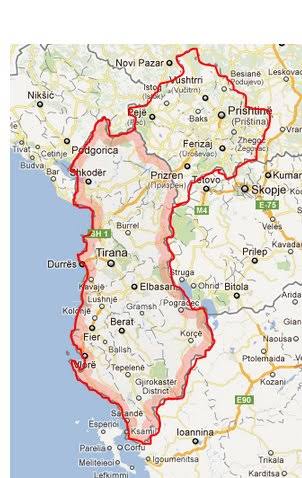
By Dr. Sadri RAMABAJA
Key Takeaways:
- The essay proposes an Albanian Federation of the two existing republics—Albania and Kosovo—as a federal state that would pool foreign policy, defence and the common market while leaving education, culture and local administration to the constituent units, thereby avoiding absorption of one by the other.
- Drawing on John Doyle’s Irish-unification planning, the author insists the idea must be converted into a detailed White Paper covering constitution, fiscal solidarity, monetary policy, transition stages and EU/NATO representation before any public vote.
- The federation is framed as compatible with European integration, increasing collective weight without expansionism, provided it rests on democratic ratification, clear power-sharing and realistic expectations rather than historical romanticism.
From National Cohesion to Functional Sovereignty in an Integrated Europe
Introduction: From the Question of Unification to the Question of State Form
The Albanian question in the twenty-first century can no longer be framed solely in the classical language of “national unification.” The political history of the Albanians has produced a more complex reality: one nation, a historically and culturally interconnected space, but two political republics—the Republic of Albania and the Republic of Kosovo.
This situation is not merely a historical legacy. It is a political reality that must be analysed in light of the transformation of the very concept of sovereignty, European integration, and the return of geopolitical competition to the continent.
The question that can now be posed is therefore not simply whether the Albanians can unite. The more consequential question is: what institutional form could achieve a higher degree of political, economic, and strategic cohesion among Albanians without undermining the legitimacy, institutions, and political identities of the two existing republics?
This is precisely where the concept of the Albanian Federation acquires its significance.
In my book The Albanian Federation: The Cohesion of the Nation-State within the EU, published in 2016, this idea was examined as the union of the two Albanian republics within a single federal entity. The federation was conceived not as a rejection of Europe, but as a new form of nation-state organisation under the conditions of European integration.
A decade later, John Doyle’s book Before the Vote: Planning for a United Ireland offers an especially important methodological insight: a project of unification cannot rest solely on a historical ideal or national sentiment. It must be able to answer the most important question in advance: what happens the day after unification?
This shifts the debate developed in this essay from symbolism to state-building.
In this sense, the two books can be read as complementary parts of a broader argument. The first, my own, formulates the problem of cohesion and its possible institutional form; the second, by John Doyle, demonstrates that such a project must be translated into a detailed constitutional, economic, legal, and social plan.
Progress along these lines, following the resolution of the institutional crisis, will depend on the institutional, social, and political consolidation of the Republic of Kosovo, as well as on the role that Pristina, as the nation’s second political centre, will play in this historical process.
I. From National Unification to the Problem of State Form
In European political history, the idea of the nation-state was long associated with the alignment of nation, territory, and sovereignty.
Modern history, however, demonstrates that this alignment is not absolute. A nation may be organised across more than one state, while a single state may encompass more than one national identity.
The central argument of my book The Albanian Federation concerns precisely this paradox: modern history offers examples of nations politically divided among several states, even though the nation itself remains one of the most powerful forces of political cohesion.
The Albanian case is one such example.
Albania emerged as a state in 1912. The Republic of Kosovo became an independent state in 2008, following a long process of resistance, state-building, and liberation struggle. In this sense, the two republics are neither temporary nor artificial realities that can simply be erased by a political act. They have established their own institutions, constitutions, administrations, political systems, and distinct republican identities.
Any serious project of unification must therefore begin from this premise: unification does not necessarily have to mean the dissolution of the existing constituent units.
This is precisely why the federal model is presented as a conceptual alternative between two extremes:
- The status quo: two separate states.
- The unitary state: a single state that completely replaces the two existing entities.
The federation proposes a third possibility: a common federal state composed of two constituent federal units.
This formula does not eliminate Albania, nor does it eliminate Kosovo. On the contrary, it places them within a new constitutional relationship.
In its simplest formulation: neither Albania absorbs Kosovo, nor Kosovo absorbs Albania; both constitute the Albanian Federation.
This is the fundamental difference between a federation and a centralising project of unification.
II. Why a Federation Rather Than a Unitary State?
In theoretical terms, a unitary state may appear simpler: one constitution, one parliament, one government, one administration, and a single legal system.
Yet precisely this formal simplicity may generate new political problems.
Albania and Kosovo have different state-building experiences. They have different legal systems, institutional traditions, and economic structures. Moreover, both have developed their own republican legitimacy.
A unitary union would immediately have to answer the question: which existing institution would absorb the other?
A federation avoids this dilemma by shifting the issue from hierarchy to the division of powers. The federal units would retain their competencies in constitutionally defined fields, while powers serving common interests would be transferred to the federal level.
In a possible model, the federal level could encompass:
- Foreign policy;
- Defence and strategic security;
- The common market;
- Trade policy;
- Strategic infrastructure;
- Energy policy in areas of federal interest;
- Selected areas of fiscal policy;
- International representation;
- Relations with European institutions;
- Common economic and strategic standards.
Meanwhile, the federal units could retain significant competencies in:
- Education;
- Culture;
- Territorial administration;
- Healthcare;
- Social policy;
- Regional development;
- Local government;
- A substantial portion of domestic public policy.
This would establish a straightforward principle: One state—two levels of legitimacy—a constitutional division of powers.
That is the logic of federalism.
III. Two Federal Units: Not a Weakness, but a Mechanism of Stability
Why two units?
Because the project must begin with the existing reality, rather than deny it.
The two existing republics are political realities. An attempt to eliminate them at the founding moment would turn unification into a process of absorption.
The federal model, by contrast, could preserve the institutional identity of Kosovo and the institutional identity of Albania, while simultaneously creating a new federal political identity.
This would not be a contradiction. A citizen could simultaneously be a citizen of a constituent federal unit and a citizen of the Federation. This is one of the defining characteristics of modern federalism: political identities can be multiple without necessarily being mutually exclusive.
In this respect, the two federal units could also serve as a constitutional safeguard against centralisation.
An Albanian Federation would not need to be constructed as a pyramid in which one republic is the “centre” and the other the “periphery.” It should instead be built on the principle of constitutional equality between the constituent units.
This would require a federal parliament that guarantees proportional representation of citizens, alongside a federal chamber in which the constituent units are represented equally, or according to a formula designed to safeguard the balance between them.
In this sense, a bicameral parliament could form part of the institutional architecture of an Albanian Federation.
IV. John Doyle’s Methodological Lesson: Do Not Vote Only on the Idea, but on the Reality That Follows
Perhaps the most important contribution that Before the Vote can make to the Albanian debate lies here. Doyle shifts attention from the abstract question of Irish unification to the practical preparations required to achieve it.
He argues that a vote on unification cannot rest solely on principle, leaving everything else “to be resolved later.” Instead, the public must have as clear an understanding as possible of the political structures, public policies, services, rights, economy, and transition process that unification would entail.
This insight has direct relevance to the Albanian project.
If the Albanian Federation is to be treated as a serious state-building project, the question cannot be limited to: Why a federation?
It must immediately be followed by further questions:
- How will the Federation be constructed?
- What kind of constitution will it have?
- How will powers be divided? How will it be financed?
- What will happen to the legal systems?
- What will happen to the public administrations?
- How will defence be organised?
- How will the education and healthcare systems be harmonised?
- How will monetary policy function?
- How will economic disparities be addressed?
- How will the Federation be represented in the European Union and NATO?
In other words, the idea must be transformed into a project.
Doyle emphasises precisely the need to map legal and institutional differences in advance, since decades of political separation produce different legal and administrative systems.
For Albania and Kosovo, this would mean preparing a White Paper—a Strategic Document on the Albanian Federation.
V. The Federation as a Constitutional Project
If the concept is taken seriously, the first step in designing the new state would be the drafting of a Federal Constitution.
It would need to define clearly:
- The federal character of the state;
- The constitutional equality of the two constituent units;
- The division of powers;
- Federal institutions;
- The institutions of the constituent federal units;
- The fiscal system;
- The mechanism of inter-federal solidarity;
- A Federal Constitutional Court;
- The protection of rights and freedoms;
- The procedure for constitutional amendment;
- Relations between the federal level and the constituent units;
- Procedures for resolving conflicts of competence.
Such a constitution must not be conceived as a ceremonial document. It must constitute the political compact between the two republics. In this sense, the Federation would first and foremost be a constitutional act.
A political agreement between governments would not be sufficient. A democratic and constitutional process would be necessary to confer full legitimacy on the new institutional architecture.
The Irish experience is particularly instructive here. Doyle stresses the importance of incorporating political structures, minority rights, and mechanisms of representation into the planning process from the outset.
For the Albanian case, this translates into a fundamental principle: the Federation cannot be an agreement among political elites; it must be a constitutional compact among citizens.
VI. The Federation as a Mechanism of Economic Convergence
One of the most common objections to any project of unification concerns economic disparities.
Yet economic differences are not automatically an argument against a federation. First and foremost, they represent a challenge that must be addressed through the federation’s economic architecture.
Doyle places this issue at the centre of planning for a united Ireland: economic comparisons must be conducted before unification, while transition costs and mechanisms for convergence must be planned in advance.
The same logic can be applied analytically to Albania and Kosovo.
The Federation would create a larger economic space, enabling common policies in the following areas:
- Infrastructure;
- Energy;
- Transport;
- Tourism;
- Agriculture;
- Industry;
- Technology;
- Higher education;
- Scientific research;
- The diaspora;
- Strategic investment.
Instead of two relatively small economies planning separately, a federal structure could generate economies of scale and strengthen their collective negotiating capacity.
In The Albanian Federation, the economy is examined from precisely this perspective: the federation is understood as an opportunity to create a common economic space and develop modern state institutions.
This prospect, however, must not be romanticised. A federation does not automatically generate prosperity. It would require a clear mechanism of fiscal solidarity, transparent rules governing transfers and investment, budgetary discipline, and policies designed to prevent the emergence of permanent dependencies between the constituent units.
The guiding principle should therefore not be “one pays, the other receives,” but rather convergence through investment, productivity, and a common market.
VII. From an International Border to a Common Federal Space
One of the most significant changes brought about by a federation would be the transformation of the political meaning of the Albania–Kosovo border.
Today, it is a border between two states. Under a federal system, it would become an internal administrative and constitutional boundary.
This would not mean the disappearance of territorial identities. Rather, it would mean that citizens, capital, goods, and services could move within a single political and economic space.
Here lies one of the most important potentials of federalism: it can achieve integration without uniformity. The federal units can retain their institutions while the boundaries between them cease to function as barriers.
This also offers a way of thinking about sovereignty under modern conditions.
Sovereignty should not necessarily be understood as a fixed quantity that one either possesses or does not possess.
In modern political systems, sovereignty can be organised across different levels: Local → Federal → European.
This may be defined as functional sovereignty: the exercise of authority at the level where it can be exercised most effectively.
VIII. The Albanian Federation and Europe: Two Levels of Cohesion
One of the fundamental ideas underpinning the concept of the Albanian Federation is that it should not be conceived as an alternative to Europe.
My 2016 book argues that the Albanian Federation and the European project can be understood as two processes that do not exclude one another. Strengthening the cohesion of the nation-state can coexist with European integration.
This idea can be expressed through a simple formula: The Albanian Nation → The Albanian Federation → An Integrated Europe.
Within this framework, the Federation would not represent a return to classical territorial nationalism. It would instead provide a more rational way of organising the Albanian political space within a Europe in which sovereignty is increasingly exercised at multiple levels.
European experience itself demonstrates that the nation-state has not disappeared as a result of European integration. On the contrary, states have transferred certain competencies to the European level while retaining a substantial portion of their national powers.
A three-level order can therefore be envisaged in theoretical terms: The Federal Units → The Albanian Federation → The European Union.
This would constitute a form of multiple-level sovereignty. From this perspective, the Federation could be interpreted not as an obstacle to Europe, but as an attempt to adapt Albanian political organisation to the logic of European integration.
IX. The Federation as a Response to Geopolitical Fragmentation
Beyond economics and constitutional design, there is also a geopolitical dimension.
A federal state comprising two units would possess greater territorial, demographic, economic, and institutional weight than either republic separately.
In The Albanian Federation, this dimension is examined as an opportunity to increase the weight of the Albanian factor in the region and establish a more balanced regional order.
An important distinction must nevertheless be made here.
An increase in state capacity must not be equated with a project of domination.
An Albanian Federation conceived in a European spirit would need to be founded upon:
- Respect for the sovereignty of neighbouring states;
- Respect for international law;
- Good-neighbourly relations;
- European integration;
- Regional cooperation;
- Democracy and the rule of law.
These principles would distinguish a federal project from classical forms of expansionist nationalism.
The Federation would represent, above all, the institutionalisation of collective capacity rather than a project of territorial expansion.
X. The Problem of Democracy and Legitimacy
Any project of this nature would fail if treated merely as an initiative of political elites. The Federation must possess democratic legitimacy.
This implies a lengthy process: Research → Public Debate → Political Negotiation → Constitutional Draft → Public Consultation → Democratic Ratification.
Doyle emphasises the importance of structured public debate and civil-society participation in planning a possible Irish unification. The same lesson applies here.
Before any final decision is taken, a broad public debate would be required on:
- Benefits;
- Costs;
- Risks;
- Constitutional models;
- The economy;
- Civil rights;
- Public administration;
- Defence;
- International relations;
- Relations with the EU and NATO.
In this way, citizens would not be voting for an abstract symbol, but for a comprehensible political architecture.
XI. Counterarguments: Why the Federation Is Not an Automatic Solution
A serious essay on the Albanian Federation cannot conclude without addressing the arguments against it.
First, there is the problem of economic asymmetry. A federation may generate tensions if fiscal transfers are perceived as unfair.
Second, there is the problem of institutional competition. If powers are not clearly defined, conflicts may arise between federal institutions and those of the constituent units.
Third, there is the problem of political legitimacy. Unification cannot be built solely on a historical argument; it requires democratic consent.
Fourth, there is the international dimension. A transformation of the constitutional status of Kosovo and Albania would have consequences for their international relations and would require exceptionally careful legal and diplomatic consideration.
Fifth, there is the problem of expectations. If citizens are promised that the federation will automatically solve the problems of development, corruption, migration, or prosperity, the project will be built on illusions.
Sixth, there is the challenge inherent in federalism itself: a federation can function effectively only where strong institutions, a constitutional culture, and effective mechanisms for resolving disputes exist.
The argument for the Federation must therefore be an argument for a feasible project, not merely for an ideal.
This is precisely where Doyle’s experience is most valuable: planning must precede decision-making rather than emerge as an improvisation afterwards. His book emphasises that a process of unification affects virtually every sphere of government and society.
XII. From Idea to Project: The White Paper on the Albanian Federation
If the concept were to move from theoretical debate to the design stage, the logical next step would be the preparation of a White Paper on the Albanian Federation.
It could include, at a minimum, the following chapters:
1. Historical and Political Foundations
The history of Albanian state-building and relations between Albania and Kosovo.
2. Federal Models
Germany, Austria, Belgium, Switzerland, and other relevant models, with particular attention to the differences between a federation and a confederation.
3. The Federal Constitution
Fundamental principles, the separation of powers, and the allocation of competencies.
4. The Two Federal Units
The status, competencies, and autonomy of the Republic of Albania and the Republic of Kosovo.
5. The Federal Parliament
The chambers, representation, and mechanisms for maintaining institutional balance.
6. The Federal Government
Its powers and responsibilities.
7. The Federal Constitutional Court
The resolution of disputes between the Federation and its constituent units.
8. The Economic System
The common market, fiscal policy, investment, and a convergence fund.
9. Monetary Policy
A common monetary framework and its relationship with the euro area.
10. Defence and Security
A common defence doctrine and its institutional architecture.
11. Foreign Policy
International representation and relations with the EU, NATO, and other states.
12. Strategic Infrastructure
Energy, railways, ports, motorways, and digital communications.
13. Education, Culture, and Science
The creation of a common academic and cultural space.
14. The Diaspora
A common policy towards the Albanian diaspora.
15. European Integration
The relationship between the Albanian Federation and the European Union.
16. Transition
The legal, administrative, and economic stages of the transition from two states to a federation.
Such a document would transform the concept from a political idea into a state-building project open to public scrutiny and debate.
XIII. A New Order of Cohesion: The Nation, the Federation, and Europe
At this point, we can return to the original question: why an Albanian Federation with two constituent units?
The answer should not be sought in history alone. It must be found in the relationship between three realities: The Albanian nation, the two existing republics, and an integrated Europe.
The nation represents the historical, cultural, and political dimension of identity. The two republics represent the institutional reality established during the twentieth and early twenty-first centuries.
Europe represents the highest level of political and economic interdependence into which the Albanian states aspire to integrate.
In this sense, the Federation could be conceived as an intermediate link: from national identity to a federal state, and from the federal state to an integrated Europe.
This is also why the concept of the Albanian Federation, as developed in my 2016 book, is positioned in relation to the European project rather than in opposition to it.
Conclusion: The Federation as a New Question of Albanian State-Building
Albanian political history has passed through several major stages. The National Renaissance formulated the idea of a political nation. The independence of 1912 established the Albanian state. The Kosovo war and the creation of the Republic of Kosovo represented a new stage in Albanian political self-determination.
The twenty-first century presents a different question to be resolved: can a new form of political cohesion be constructed that does not erase these achievements, but instead places them within a broader institutional architecture?
The concept of the Albanian Federation seeks precisely to open this debate.
From this perspective, the Federation would not represent a return to a centralised model of the nation-state, but an attempt to adapt Albanian state-building to the new realities of an integrated Europe. It would not necessarily require the disappearance of the Republic of Albania and the Republic of Kosovo as political entities. On the contrary, it could transform them into the two constituent units of a new federal order.
Its fundamental formula could therefore be expressed as follows: Two existing republics, one federal state, one common market, one shared strategic policy, and a common Albanian political space within an integrated Europe.
Such a Federation, however, cannot be built on political romanticism. It would require a constitution, institutions, a functioning economy, fiscal discipline, democratic mechanisms, legal safeguards, and a detailed transition plan.
Here lies the most important lesson to be drawn from Doyle: it is not enough to know what one wishes to build; one must also know how the proposed structure will function.
Before the Vote places precisely this logic at the centre of planning for Irish unification: before a decision is taken, there must be as clear a picture as possible of the institutions, economy, public services, law, rights, and transition arrangements.
This makes Doyle’s book a methodological complement to the concept of the Albanian Federation.
If The Albanian Federation: The Cohesion of the Nation-State within the EU formulated the question of why a new form of Albanian political cohesion is needed, Before the Vote compels us to ask how that cohesion would function in practice.
At this point, the debate on the Albanian Federation enters a new phase. It is no longer merely a debate about history. Nor is it simply a debate about identity or borders. It has become a debate about the architecture of the state.
This is precisely where the deeper meaning of the Albanian Federation lies: it can be studied as an attempt to overcome the contradiction between the fact that Albanians have two republics and the aspiration to achieve a higher level of political cohesion.
Ultimately, a nation is measured not only by its capacity to dream of a common future, but also by its ability to translate that future into democratic, sustainable, and European institutions.
In this sense, the Albanian Federation can be regarded as one of the major questions of Albanian state-building in the twenty-first century:
How can cohesion be achieved without centralisation, unification without absorption, sovereignty without isolation, and Albanian statehood without detachment from Europe?
The possible answer offered by federalism is: Two republics. One federation. One common constitutional order. One integrated economic space. And one European orientation.
This is not a solution that can be taken for granted. It is a political and constitutional project that would have to be tested through argument, research, public debate, and democratic will.
For precisely this reason, the question of the Albanian Federation should not be treated merely as nostalgia for an unrealised historical unification. It can instead be posed as a contemporary question concerning how a nation divided between two republics can organise its cohesion in an era of multiple-level sovereignty and European integration.
From unification as an ideal to the federation as a project: this is the conceptual transition that the Albanian debate needs.
Selected Bibliography
Books and Academic Studies
- Anderson, Benedict. 2006. Imagined Communities: Reflections on the Origin and Spread of Nationalism. Revised edition. London: Verso.
- Burgess, Michael. 2006. Comparative Federalism: Theory and Practice. London: Routledge.
- Doyle, John. 2026. Before the Vote: Planning for a United Ireland. Dublin: DCU Press. https://doi.org/10.59949/9781067618322.
- Elazar, Daniel J. 1987. Exploring Federalism. Tuscaloosa: University of Alabama Press.
- Gellner, Ernest. 1983. Nations and Nationalism. Oxford: Blackwell.
- Hobsbawm, Eric J. 1990. Nations and Nationalism since 1780: Programme, Myth, Reality. Cambridge: Cambridge University Press.
- Lijphart, Arend. 2012. Patterns of Democracy: Government Forms and Performance in Thirty-Six Countries. 2nd ed. New Haven, CT: Yale University Press.
- Ramabaja, Sadri. 2016. Federata Shqiptare: Kohezioni i shtetit-komb në BE [The Albanian Federation: The Cohesion of the Nation-State within the EU]. Ljubljana: Albanica, Znanstveno-Raziskovalni Institut.
- Ramabaja, Sadri. 2022. Rikthimi i gjeopolitikës: Federata Shqiptare përballë “Botës Serbe” [The Return of Geopolitics: The Albanian Federation Confronting the “Serbian World”]. Prishtina: Instituti Shqiptar për Gjeopolitikë.
- Watts, Ronald L. 2008. Comparing Federal Systems. 3rd ed. Montreal and Kingston: McGill-Queen’s University Press.
Constitutional and Legal Documents
- Constitution of the Republic of Albania. 1998, as amended.
- Constitution of the Republic of Kosovo. 2008, as amended.
- European Union. 2016. Consolidated Version of the Treaty on European Union. Official Journal of the European Union C 202, June 7, 2016.
- Federal Republic of Germany. Basic Law for the Federal Republic of Germany. 1949, as amended.
