
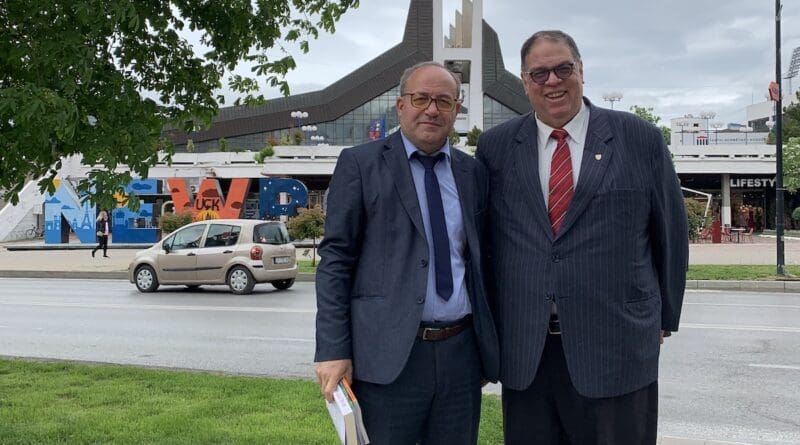
In the photo Dr. Sadri Ramabaja and Dr. Benjamín Fernández Bogado (from Paraguay), in Pristina, Republic of Kosovo (2024). Photo Credit: Peter Tase
By Peter Tase
In the modern history of Southeast Europe, the Albanian geopolitical space has been constantly the object of rivalries erupting from its neighbouring countries, where the interests of regional and international powers have been juxtaposed and shaped cyclical social and political clashes with the legitimate aspirations of Albanians for self-determination, sovereignty and economic prosperity. Although at the end of XX century Tirana and Prishtina encountered significant improvements in the achievement of political status of Albanians, especially with the liberation of Kosova and the consolidation of the Albanian state as a member of NATO; the competition for intromission and malignant influence in the Albanian geopolitical space has not disappeared. On the contrary, these interventions are taking new forms, shapes and variations emanating during the first decades of the 21st century.
In an interview for Eurasia Review Journal, Dr. Sadri Ramabaja (Executive Director of Albanian Institute for Geopolitics) provides a lengthy analysis on the current geostrategic and technological context where this region of Europe is headed: “In this context, information technologies, artificial intelligence, social networks and mass media have become important instruments for exercising political influence. The battles of the future will not only take place on the physical borders of states, geographies and mineral resources but also in the digital space, in the field of public perceptions and in the control of strategic narratives. The argument on the theoretical issue of John J. Mearsheimer’s offensive realism is a relevant matter that affects the execution of the foreign policy of several nations in Europe.”
Dr. Ramabaja emphasizes: “John Mearsheimer’s offensive realism offers a more straightforward explanation of state behaviour in our days, while addressing the behaviour of regional powers that constantly seek to maximize their influence and prevent the emergence of potential rivals in spaces that they consider part of their strategic interest. In this sense, efforts to limit the consolidation of the Albanian regional factor can be interpreted not as sporadic phenomena, but as part of the common logic of competition between state actors in the Balkans. In this theoretical charter, the institutional crises in Kosova and the phenomenon of oligarchic concentration of wealth and capital in Albania take on a broader dimension than that of everyday politics. They are not only problems of internal governance but also factors that directly affect the capacity of the Albanian nation to act as an independent subject in the regional arena. A state corroded by fragile institutions, a weaker economy, and a fragmented political elite is more exposed to external influences, regardless of the formal alliances it may have. In contemporary international relations literature, the concept of hybrid warfare describes the combination of political, economic, informational, technological, and psychological means to achieve strategic objectives without the direct use of military force. In this context, states that aim to maintain or expand their regional influence no longer rely exclusively on traditional instruments of diplomacy or military power.”
In the case of Western Balkans, historical rivalries continue to manifest themselves through malignant efforts to orient political processes, influence public opinion, and condition the economic development of the countries in the region. As a result, the Albanian space remains overwhelmingly a vulnerable ground where different strategic interests intersect, often articulated through local media, political, economic, or nongovernmental actors. About these regional rivalries Dr. Sadri RAMABAJA states: “Artificial intelligence and advanced communication technologies are significantly increasing the potential to introduce new political elites and further inflame these social processes. Information manipulation, artificial content production, algorithmic influence on public opinion and fragmentation of social discourse are becoming integral parts of the new architecture of geopolitical competition. Therefore, the fundamental challenge for Albanians in the coming decades is not only related to the preservation of territorial sovereignty, but to building what contemporary security literature calls as national resilience. This means the ability of the state and society to cope with economic, informational, technological and political pressures without losing decision-making autonomy. In this context, any development model that creates new strategic dependencies must be carefully examined. The insistence of international partners that Kosova should orient itself towards liquefied natural gas as the main energy source raises important questions in relation to national resilience. Kosova currently has neither the necessary infrastructure, nor the technical capacities, nor the institutional tradition to rely on such an energy grid. Consequently, an imposed transition that is not adapted to the real conditions of the country could create new forms of economic, technological and geopolitical dependence.”
In an interview given to Kosova’s public TV [RTK] on June 6th, the nation’s acting Prime Minister Albin Kurti, speaking on the issue of US energy and gas provisions, reiterated his position that Kosova is more interested in exploiting its own resources than building a natural gas infrastructure. He stated: “We are interested in gasifying our coal that is on the surface.”
At the same time Albin Kurti did not reject US gas supplies as an alternative energy source. He hinted that Kosova intends to be included in the Vlora energy project, seeing it as a joint Albanian platform. According to the interpretation of his statement, the idea is for Kosova to be a co-shareholder or partner in the energy capacities related to the Vlora LNG terminal and the Vlora power plant, which would allow it to benefit from energy produced from US gas without having to immediately build an internal gasification network.
This approach is consistent with the idea of creating a more integrated Albanian energy market, where Vlora could serve as an energy hub for the entire Albanian space in the Balkans. National resilience is not only measured by the alliances that a state possesses, but also by the ability to maintain control over strategic sectors and to make decisions that stem from the long-term interests of its society. Before this backdrop, the diversification of energy resources, the use of local potentials and the gradual development of internal capacities appear to be more sustainable components of national security than the adoption of models that could make the country dependent on new supply chains and vulnerable to external decision-making.
In the end, if the XIX century was the era of national survival, XX century was that of liberation and state building, the XXI century is emerging as the era of consolidation of national power. In this historical phase, the success of Albanians will not only be measured by the existence of their states, but by their ability to turn these territories into centers of economic gravity, knowledge, development of large luxurious tourism projects, technological innovation and strategic security. Only in this historic stage Albanian ethnographic territories are enviably poised to sustain Supply Chain Fragmentation, contain regional geopolitical rivalries and genuinely shape their identity moving forward.
Burimi:
https://www.eurasiareview.com/14062026-dr-sadri-ramabaja-the-geopolitics-of-albanian-territories-and-southeastern-europe-interview/

About Peter Tase
Peter Tase is a freelance writer and journalist of International Relations, Latin American and Southern Caucasus current affairs. He is the author of America’s first book published on the historical and archeological treasures of the Autonomous Republic of Nakhchivan (Republic of Azerbaijan); has authored and published four books on the Foreign Policy and current economic – political events of the Government of Azerbaijan. Tase has written about International Relations for Eurasia Review Journal since June 2012.
